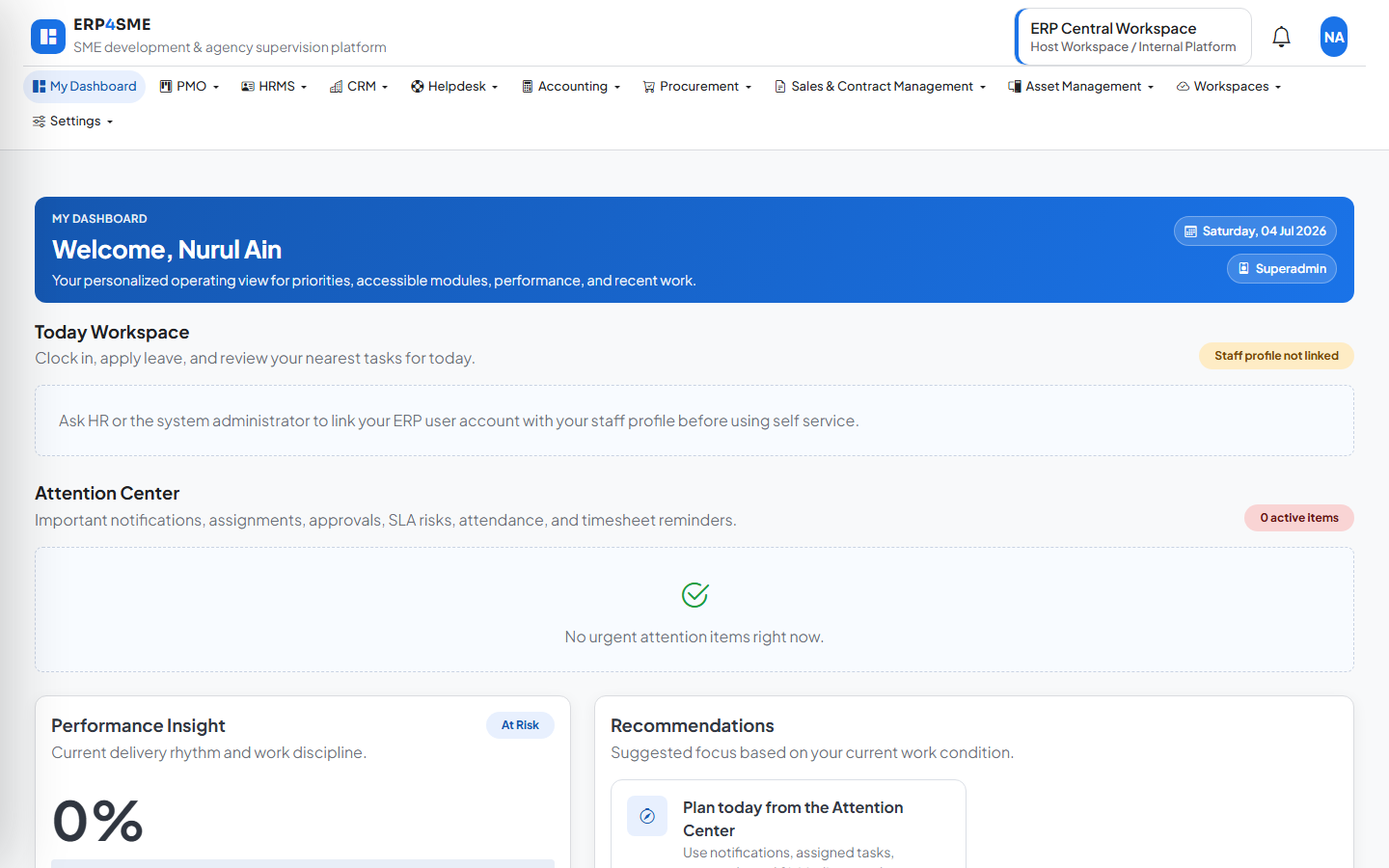
My Dashboard
Personalized priorities, attendance, tasks, attention items, and module shortcuts.
ERP4SME is a Malaysian enterprise operations platform with operational PMO, HRMS payroll, accounting, and assets — plus CRM, sales quote-to-cash, procurement, helpdesk SLA, and Host/Operator/Tenant SaaS control in one integrated workspace.
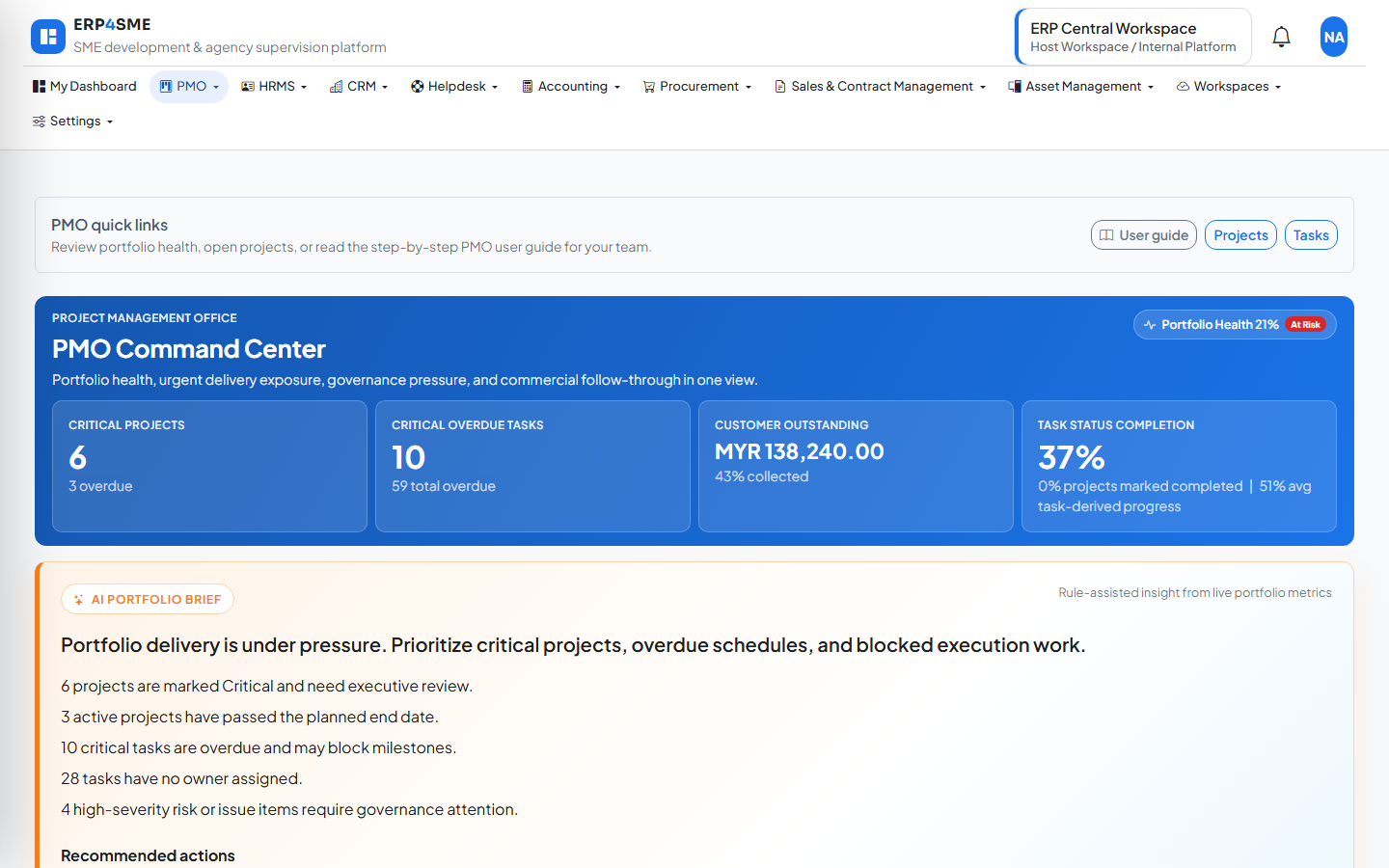
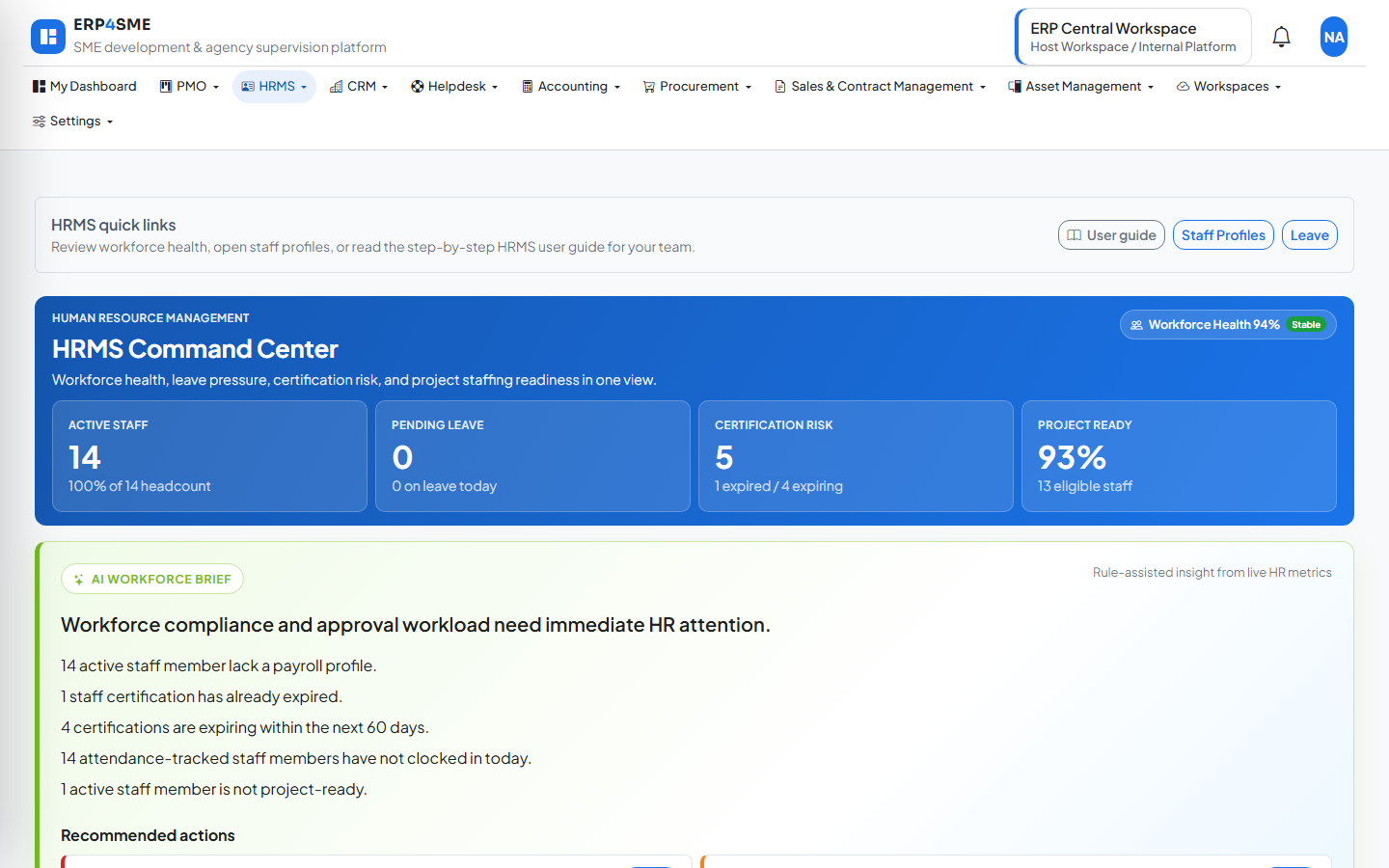
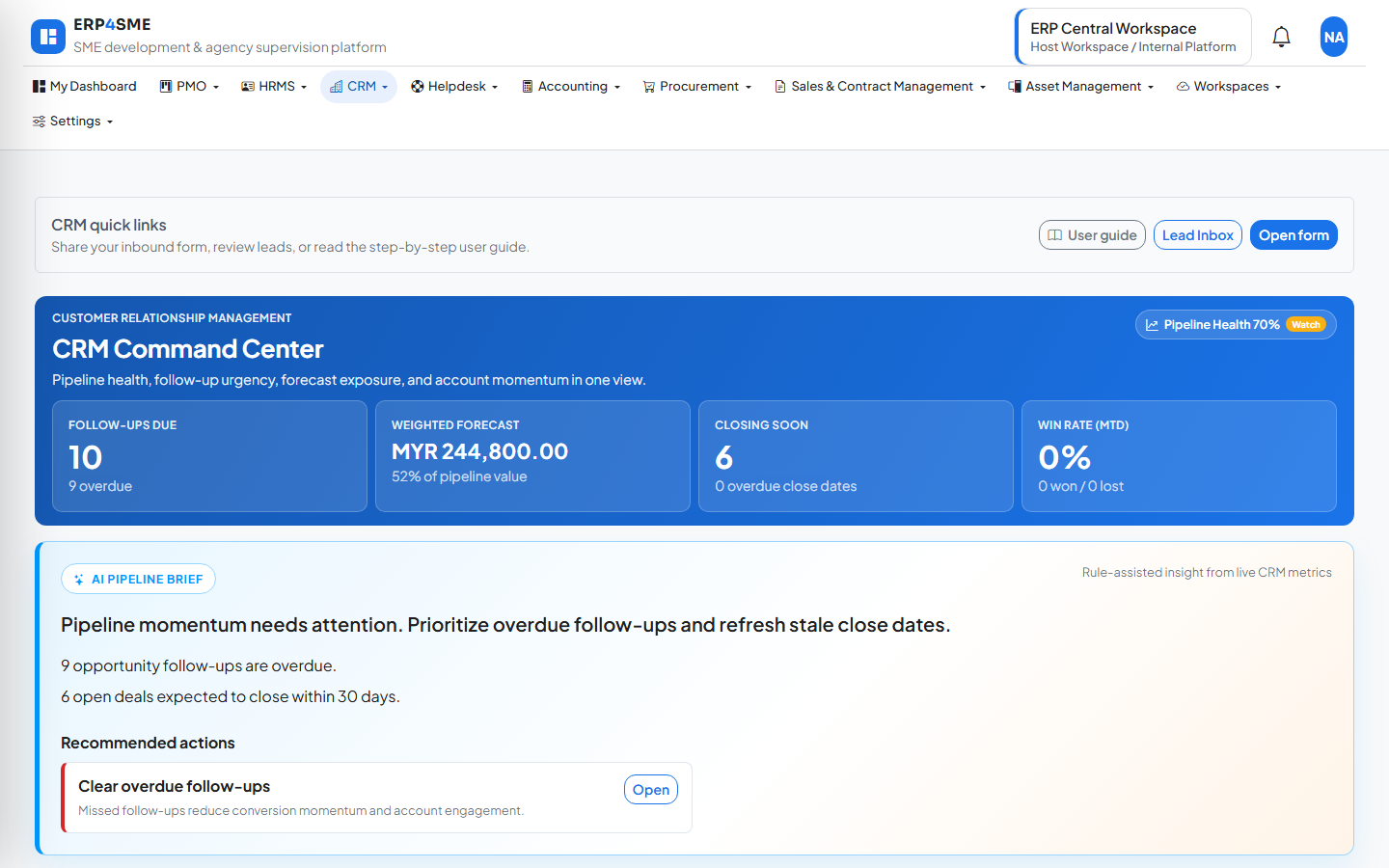
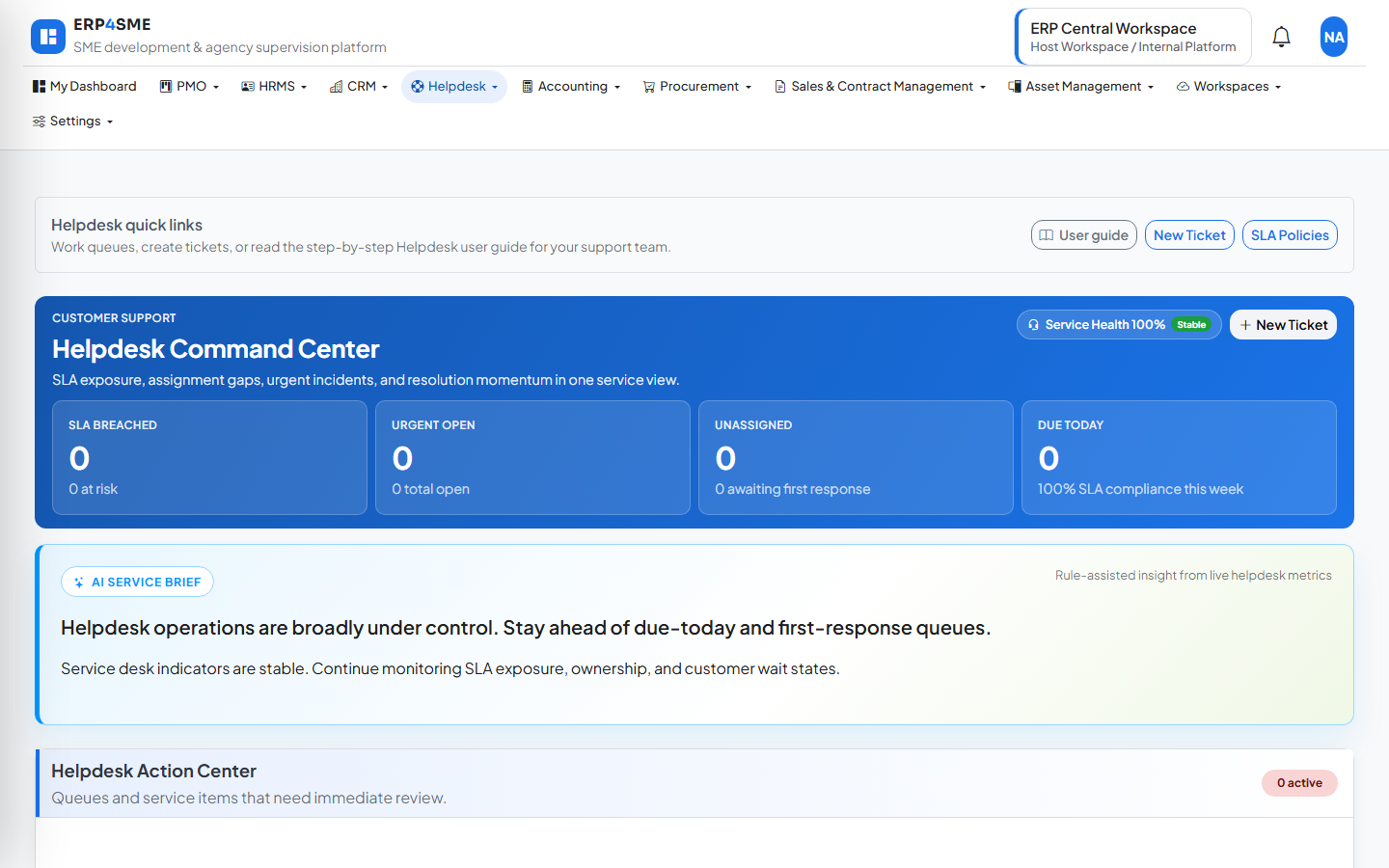
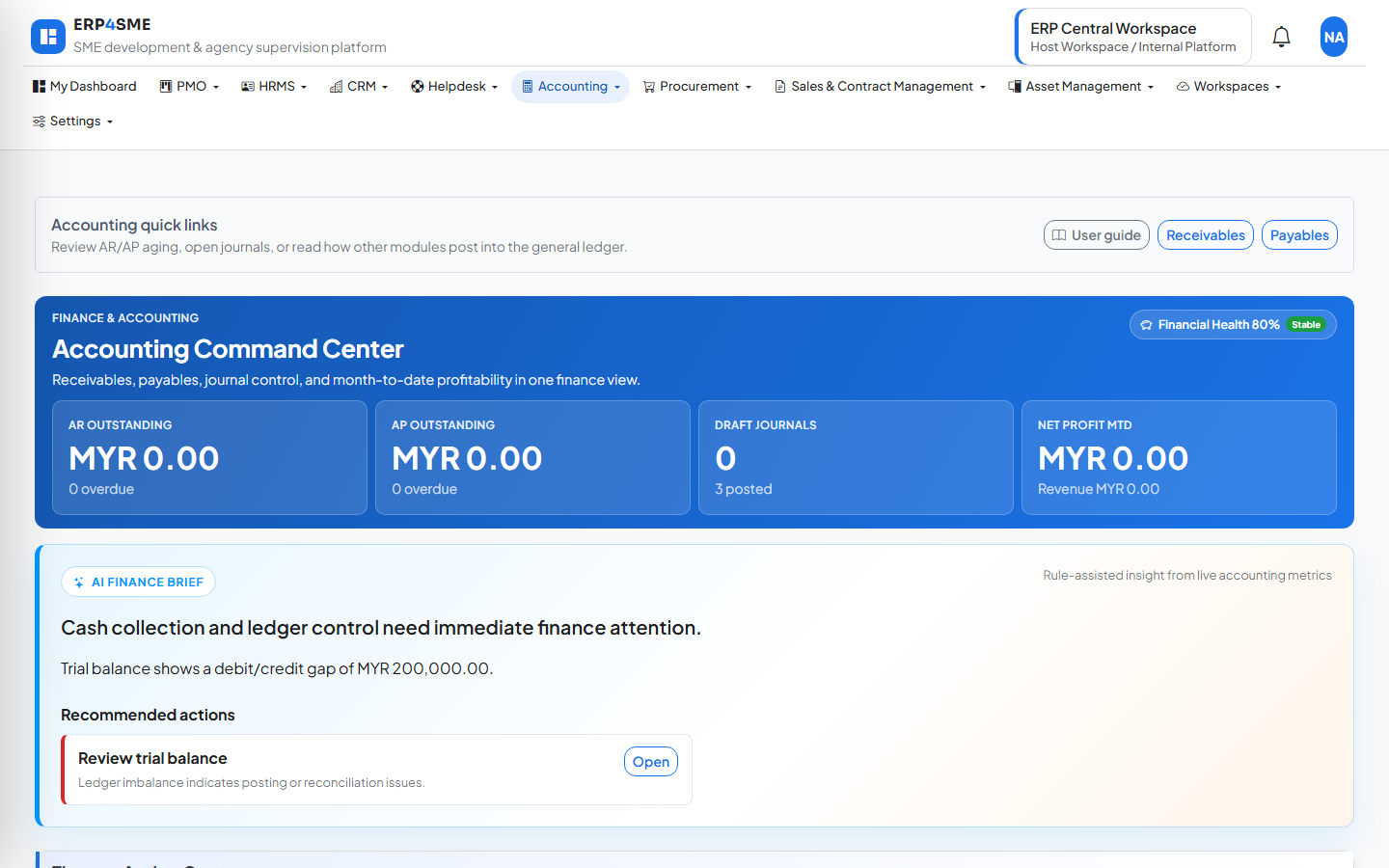
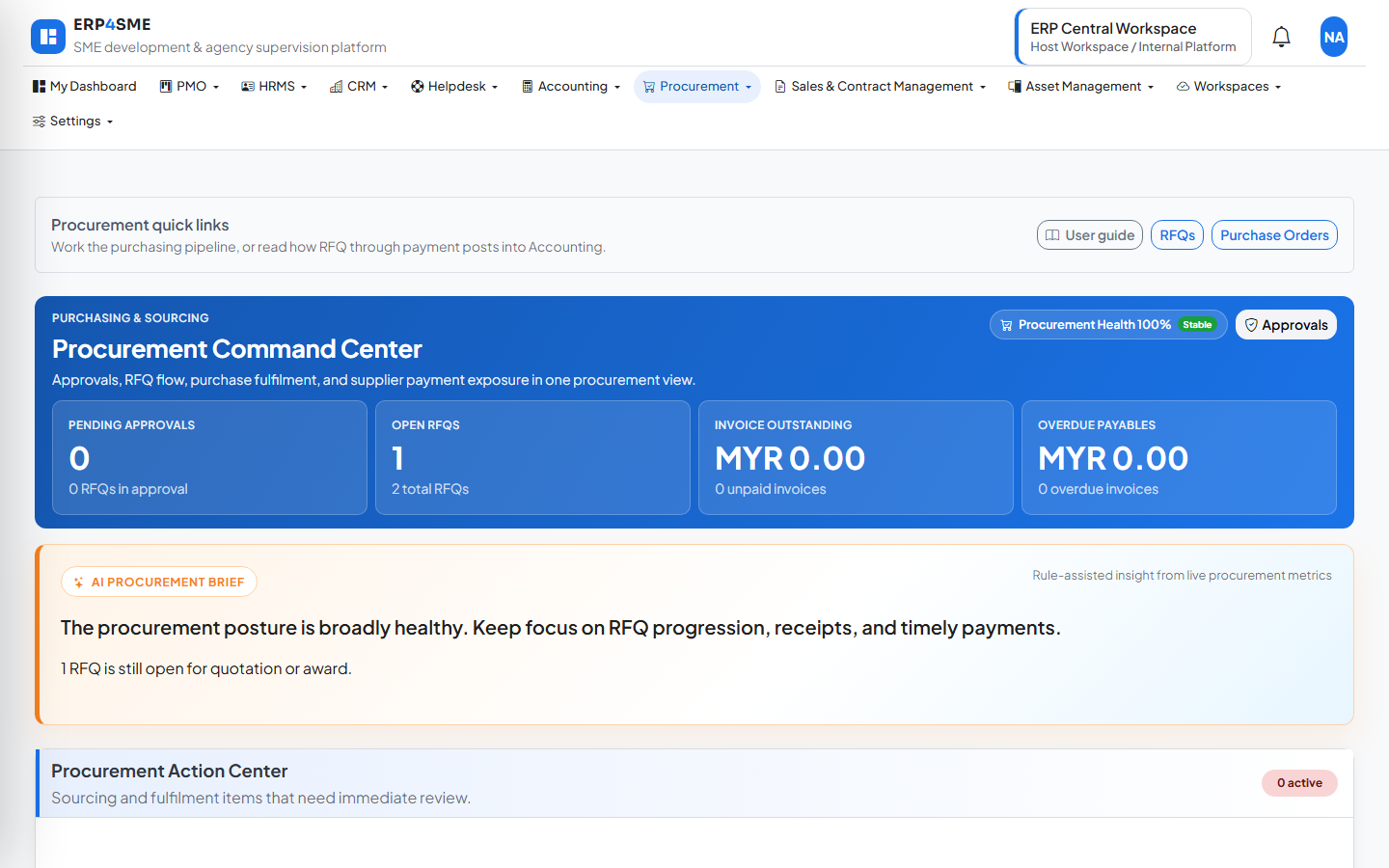
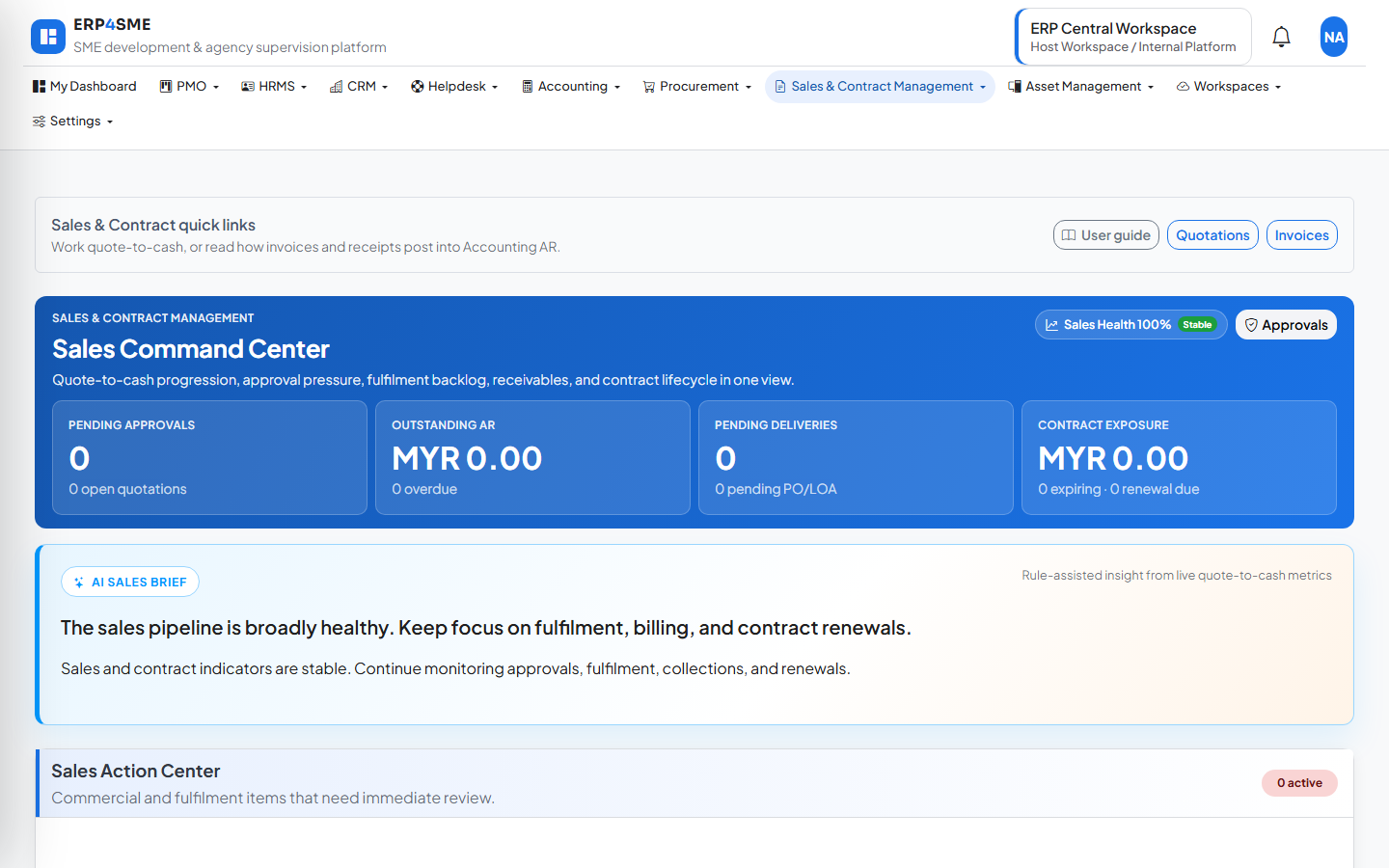
ERP4SME gives each department its own working space while keeping projects, approvals, finance and outcomes connected for leadership.
Disconnected systems
Lack of visibility
Delayed reporting
Manual administration
Approval bottlenecks
Fragmented quote-to-cash
The strongest value of ERP4SME is the connected operating flow: sales work becomes delivery work, delivery becomes billing, and billing becomes management reporting.
Operational modules cover PMO, HRMS, CRM, sales, procurement, helpdesk, accounting, assets, and SaaS tenants—ready for day-to-day enterprise operations.
ERP4SME is built for organisations that need accountable delivery, department operations, sales control and local operational fit.
Traditional ERP often handles back-office transactions. ERP4SME adds the project, sales, tenant and department operating layer around those transactions.
| Capability | Traditional ERP | ERP4SME |
|---|---|---|
| ERP (Finance, Procurement, Assets) | ✓ | ✓ |
| PMO delivery governance | Limited | ✓ |
| HRMS + Malaysia payroll | Limited | ✓ |
| CRM + quote-to-cash sales | Partial | ✓ |
| Helpdesk SLA operations | ✗ | ✓ |
| Host / Operator / Tenant SaaS | Limited | ✓ |
| Cross-module GL posting | Partial | ✓ |
| In-app module user guides | ✗ | ✓ |
Use larger platform screenshots during demos so decision makers can see the real interface, not just abstract module names.
Give buyers a temporary workspace that already feels alive, with realistic records across operations, delivery, finance and reporting.
The demo should help users explore end-to-end workflows immediately instead of starting from an empty system.
Position ERP4SME around business improvements that decision makers can recognize: faster reporting, connected quote-to-cash and stronger project visibility.
“Reduced project reporting time by 60%.”
Consulting Firm“Quote-to-cash in one sales workspace.”
Professional Services“Improved monitoring across 500 SMEs.”
SME Development AgencyERP4SME is built around tenant separation, role control, activity visibility and approval governance so multi-organisation rollouts can stay controlled.
Use the public resources to understand the modules, target industries, and security model.
Live readiness across core modules — including in-app user guides for PMO, HRMS, Accounting, Procurement, Sales, Helpdesk, Assets, and Host/Operator/Tenant workspaces.
Core PMO delivery with scoped dashboards, task-derived project progress, workflow board, Gantt timeline, reports, finance, risks, issues, documents, and an in-app user guide.
Host, Operator, and Tenant workspaces with onboarding, usage, subscription checks, plan-change flow, Operator Program, and an adaptive workspace user guide.
HRMS covers staff profiles, leave, attendance, recruitment, staff claims, monthly Malaysia payroll with statutory GL buckets, payslips, ESS payslip access, and an in-app user guide.
CRM covers organizations, contacts, pipeline, activity timeline, won conversion, lead capture, account scoring, follow-up notifications, dashboard, Sales handoff, and an in-app user guide.
Sales & Contract Management supports quotation-to-cash plus contract lifecycle: quotations, PO/LOA, sales orders, deliveries, invoices, receipts, MyInvois fields, approvals, contracts, and an in-app user guide.
Helpdesk dashboard, ticket queue, ticket lifecycle, SLA policies, project SLA overrides, quick filters, agent workload, SLA breach reporting, and an in-app user guide.
Malaysia-ready accounting with SST, bank reconciliation, fiscal periods, statutory remittances, SST-02, recurring AR/AP, cross-module GL posting from sales, procurement, payroll, claims and assets, plus an in-app user guide.
Procurement covers purchase requisitions through supplier payment vouchers with linked accounting AP documents, approval settings, and an in-app user guide.
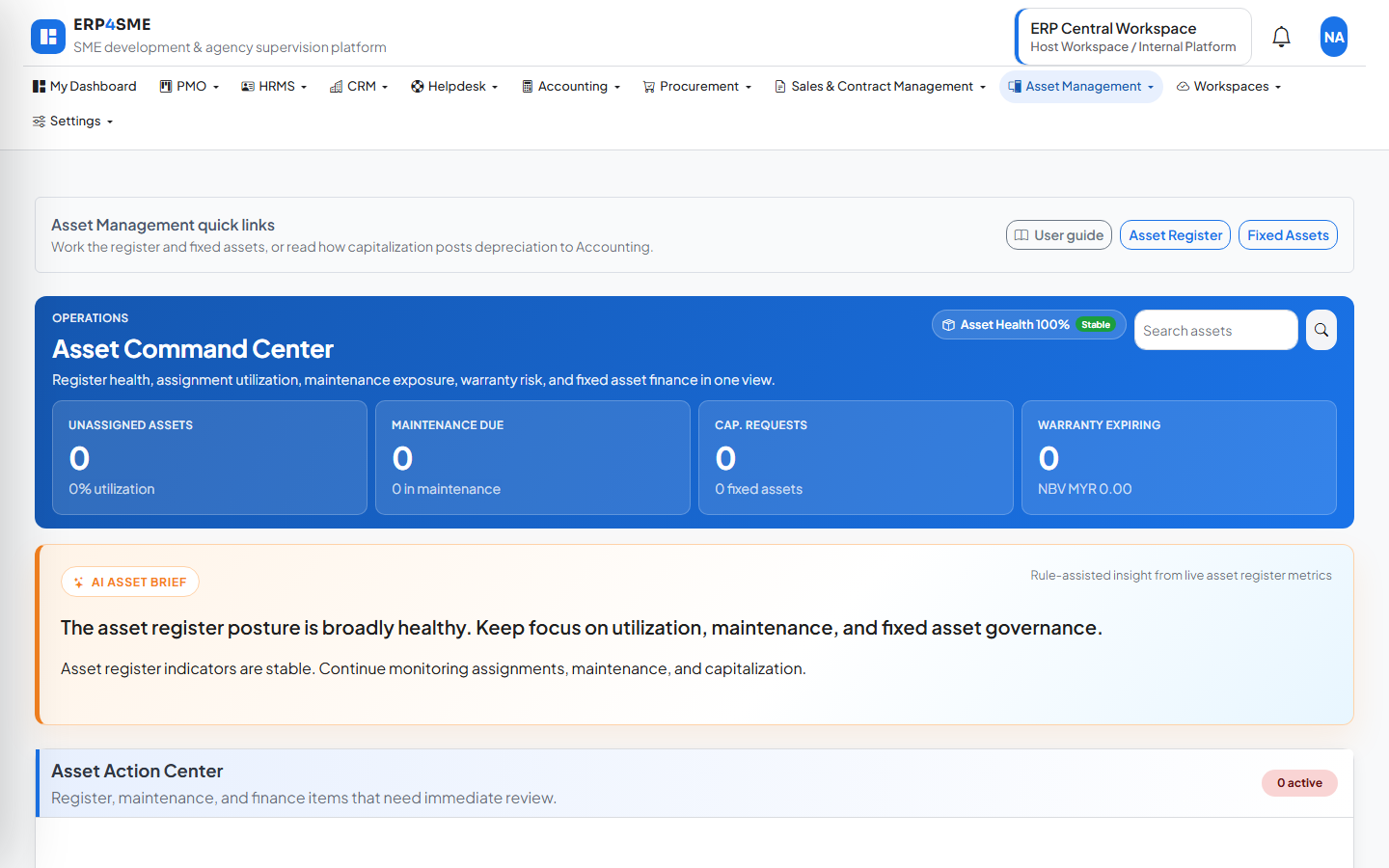
Asset register, categories, locations, assignments, maintenance, disposal, fixed-asset capitalization, depreciation GL posting, reports, and an in-app user guide.
ERP4SME supports cloud and on-premise deployment conversations, tenant administration, role-based access, audit visibility and API-ready expansion. It can begin as a PMO, HRMS, sales, procurement or finance platform, then grow into a unified enterprise operating layer.
Launch a workspace, request a guided demo or talk through the best rollout path for your organisation.